Capability at a Glance: Design Guidelines for Intuitive Avatars Communicating Augmented Actions in Virtual Reality
Yang Lu,
Tianyu Zhang,
Jiamu Tang,
Yanna Lin,
Jiankun Yang,
Longyu Zhang,
Shijian Luo,
Yukang Yan.
Published at
CHI
2026
Abstract
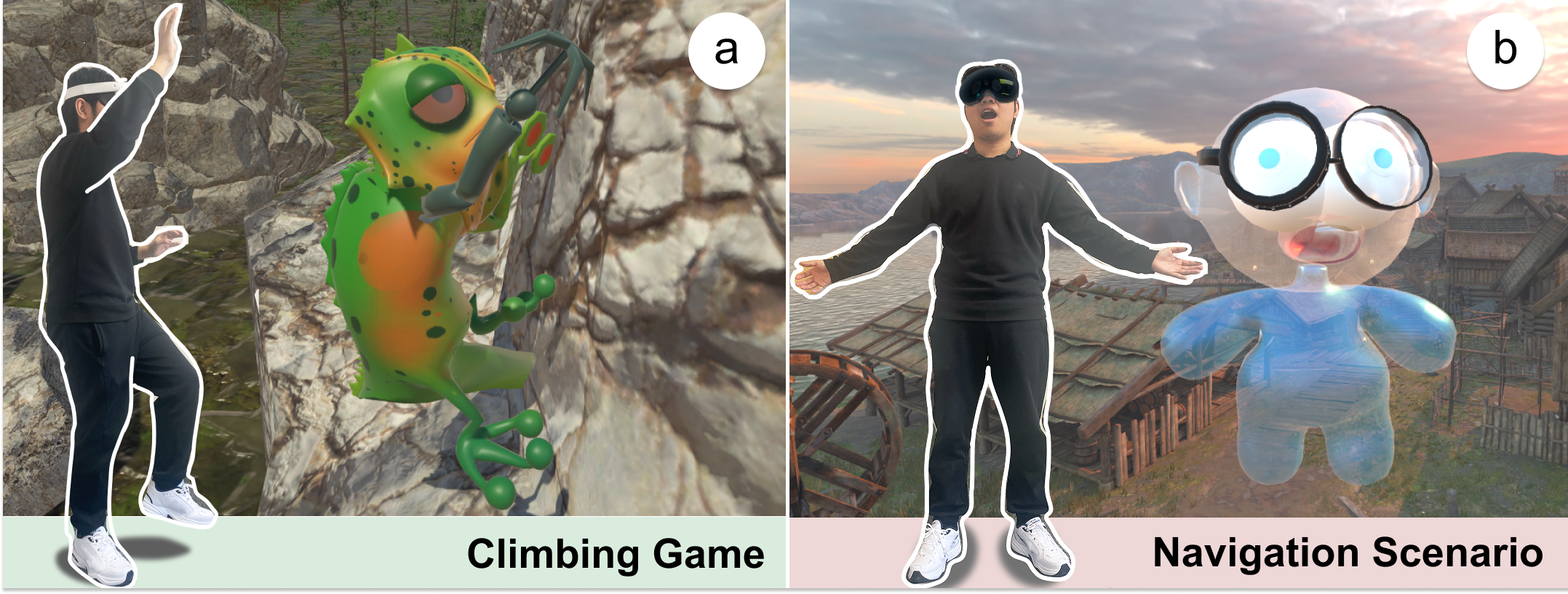
Virtual Reality (VR) enables users to engage with capabilities beyond human limitations, but it is not always obvious how to trigger these capabilities. Taking the lens of Affordance [35], we believe avatar design is the key to solving this issue, which ideally should communicate its capabilities and how to activate them. To understand the current practice, we selected eight capabilities across four categories and invited twelve professional designers to design avatars that communicate the capabilities and their corresponding interactions. From the resulting designs, we formed 16 guidelines to provide general and category-specific recommendations. Then, we validated these guidelines by letting two groups of twelve participants design avatars with and without guidelines. Participants rated the guidelines’ clarity and usefulness highly. External judges confirmed that avatars designed with the guidelines were more intuitive in conveying the capabilities and interaction methods. Finally, we demonstrated the applicability of the guidelines in avatar design for four VR applications
Materials
Bibtex
@inproceedings{10.1145/3772318.3790609, author = {Lu, Yang and Zhang, Tianyu and Tang, Jiamu and Lin, Yanna and Yang, Jiankun and Zhang, Longyu and Luo, Shijian and Yan, Yukang}, title = {Capability at a Glance: Design Guidelines for Intuitive Avatars Communicating Augmented Actions in Virtual Reality}, year = {2026}, isbn = {9798400722783}, publisher = {Association for Computing Machinery}, address = {New York, NY, USA}, url = {https://doi.org/10.1145/3772318.3790609}, doi = {10.1145/3772318.3790609}, abstract = {Virtual Reality (VR) enables users to engage with capabilities beyond human limitations, but it is not always obvious how to trigger these capabilities. Taking the lens of Affordance [35], we believe avatar design is the key to solving this issue, which ideally should communicate its capabilities and how to activate them. To understand the current practice, we selected eight capabilities across four categories and invited twelve professional designers to design avatars that communicate the capabilities and their corresponding interactions. From the resulting designs, we formed 16 guidelines to provide general and category-specific recommendations. Then, we validated these guidelines by letting two groups of twelve participants design avatars with and without guidelines. Participants rated the guidelines’ clarity and usefulness highly. External judges confirmed that avatars designed with the guidelines were more intuitive in conveying the capabilities and interaction methods. Finally, we demonstrated the applicability of the guidelines in avatar design for four VR applications.}, booktitle = {Proceedings of the 2026 CHI Conference on Human Factors in Computing Systems}, articleno = {310}, numpages = {19}, keywords = {Avatar Design, Virtual Reality, Guideline, Affordance}, location = { }, series = {CHI '26} }